📁 Installing gokapi
gokapi is a simple, self-hosted file sharing server with automatic expiration and encryption support. Ideal for teams or individuals who want privacy, control, and no clutter.
Features:
- ⏳ File shares automatically expire after a chosen number of downloads or days
- 👥 User roles provide controlled access so only registered users can upload
- 🔁 Identical files are deduplicated to avoid wasting storage space
- ☁️ Files can be stored in AWS S3 or any S3-compatible service if desired
- 🔐 Uploads can be encrypted, including full end-to-end encryption
Info
The project is open-source and can be downloaded here: https://github.com/Forceu/Gokapi.
📥 Installation
This section describes how to install and run Podman services using systemd Quadlet, enabling containers to restart automatically. It allows the service to run in its own isolated rootless environment with a dedicated Linux user.
📋 Requirements
⚙️ Configuration
📋 Service Setup
Info
Please follow the following installation steps:
Define Service Variables
# define the service name
SERVICE_NAME=gokapi
Initialize Service Environment
# built-in bash safety and SERVICE_NAME validation
set -euo pipefail; [ -n "${SERVICE_NAME:-}" ] || { echo "SERVICE_NAME is empty"; exit 1; }

# automatically generate variables
SERVICE_HOME="/media/ssd/podman-users/${SERVICE_NAME}"
SERVICE_DIR="/media/ssd/podman/${SERVICE_NAME}"
SERVICE_USER="${SERVICE_NAME}_svc"
SERVICE_ADMIN="${SERVICE_NAME}_admins"
🔐 Service Isolation
Configure Rootless Podman UID/GID Namespace Mappings
# allocate rootless Podman UID/GID mappings if missing
SUBID_SIZE=65536
allocate_subids_if_missing() {
  local user="$1"
  local start
  if ! grep -q "^${user}:" /etc/subuid; then
    start="$(awk -F: 'BEGIN { max = 100000 } { end = $2 + $3; if (end > max) max = end } END { print max }' /etc/subuid)"
    sudo usermod --add-subuids "${start}-$((start + SUBID_SIZE - 1))" "$user"
  fi
  if ! grep -q "^${user}:" /etc/subgid; then
    start="$(awk -F: 'BEGIN { max = 100000 } { end = $2 + $3; if (end > max) max = end } END { print max }' /etc/subgid)"
    sudo usermod --add-subgids "${start}-$((start + SUBID_SIZE - 1))" "$user"
  fi
}
allocate_subids_if_missing "${SERVICE_USER}"

# verify rootless Podman UID/GID namespace mappings exist
grep -q "^${SERVICE_USER}:" /etc/subuid || { echo "ERROR: missing subuid mappings for ${SERVICE_USER}"; exit 1; }
grep -q "^${SERVICE_USER}:" /etc/subgid || { echo "ERROR: missing subgid mappings for ${SERVICE_USER}"; exit 1; }

# validate that all subordinate ID ranges in a file are non-overlapping
validate_subid_ranges() {
  local file="$1"
  awk -F: '
    {
      start = $2
      end   = $2 + $3 - 1
      for (i = 1; i <= count; i++) {
        if (start <= ends[i] && end >= starts[i]) {
          printf "ERROR: overlapping ranges in %s\n", FILENAME
          printf "  %s:%s:%s overlaps %s:%s:%s\n",
            $1, $2, $3,
            names[i], starts[i], sizes[i]
          exit 1
        }
      }
      count++
      names[count]  = $1
      starts[count] = start
      ends[count]   = end
      sizes[count]  = $3
    }
  ' "$file"
}
validate_subid_ranges /etc/subuid
validate_subid_ranges /etc/subgid

# configure the rootless storage driver BEFORE Podman first initializes its storage.
# fuse-overlayfs is a reliable rootless overlay backend and avoids kernel-version
# quirks of native rootless overlay on ARM/Armbian. It is optional with the default
# userns used here, but recommended; set it before the first storage init so no
# 'podman system reset' is needed later.
sudo -u "${SERVICE_USER}" mkdir -p "${SERVICE_HOME}/.config/containers"
sudo -u "${SERVICE_USER}" tee "${SERVICE_HOME}/.config/containers/storage.conf" >/dev/null <<'EOF'
[storage]
driver = "overlay"

[storage.options.overlay]
mount_program = "/usr/bin/fuse-overlayfs"
EOF

# rebuild rootless Podman state to ensure existing containers/storage use current namespace mappings
# use a login shell (-i) so HOME points at the service user's home
# (storage now initializes with fuse-overlayfs; no 'podman system reset' needed)
sudo -iu "${SERVICE_USER}" podman system migrate
Configure Secure Service Directory Permissions
# Apply the admin/service ACL policy to one directory tree, deterministically.
#   $1 = tree to treat
#   $2 = (optional) a sub-path to skip entirely (e.g. a container data subtree)
#
# Why setfacl, not chmod: on an ACL'd tree, chmod edits only the mask, never group::,
# so stale execute bits survive. setfacl sets every entry explicitly (mask included),
# lowercase — the result is reproducible and no execute bit can resurface.
apply_acl_tree() {
    local tree="$1"
    local skip="${2:-}"
    local prune=()
    [ -n "$skip" ] && prune=( -path "$skip" -prune -o )                                         # skip this subtree if a 2nd arg is given

    sudo find "$tree" "${prune[@]}" -exec chown "${SERVICE_USER}:${SERVICE_ADMIN}" {} +         # service user owns; admin group is the owning group

    # directories — access ACL (perms on the existing dirs)
    sudo find "$tree" "${prune[@]}" -type d -exec setfacl    -m g:${SERVICE_ADMIN}:rwx {} +     # admin group: access existing dirs
    sudo find "$tree" "${prune[@]}" -type d -exec setfacl    -m u:${SERVICE_USER}:rwx {} +      # service user: access existing dirs
    sudo find "$tree" "${prune[@]}" -type d -exec setfacl    -m u::rwx,g::rwx,o::-,m::rwx {} +  # owner/group rwx, deny others, pin mask rwx

    # directories — default ACL (inherited by NEW files/dirs created later)
    sudo find "$tree" "${prune[@]}" -type d -exec setfacl -d -m g:${SERVICE_ADMIN}:rwx {} +     # admin group: inherit access on new items
    sudo find "$tree" "${prune[@]}" -type d -exec setfacl -d -m u:${SERVICE_USER}:rwx {} +      # service user: inherit access on new items
    sudo find "$tree" "${prune[@]}" -type d -exec setfacl -d -m u::rwx,g::rwx,o::- {} +         # default owner/group/other for new items

    # files — access ACL (rw only, never executable)
    sudo find "$tree" "${prune[@]}" -type f -exec setfacl    -m g:${SERVICE_ADMIN}:rw {} +      # admin group: access existing files
    sudo find "$tree" "${prune[@]}" -type f -exec setfacl    -m u:${SERVICE_USER}:rw {} +       # service user: access existing files
    sudo find "$tree" "${prune[@]}" -type f -exec setfacl    -m u::rw,g::rw,o::-,m::rw {} +     # owner/group rw, deny others, pin mask rw

    sudo find "$tree" "${prune[@]}" -type d -exec chmod g+s {} +                                # setgid: new items inherit the group (a MODE bit; ACLs can't set it)
}

# --- SERVICE_HOME: Podman's private runtime home ------------------------------
# Own the home + set setgid, then ACL ONLY the .config subtree (containers.conf,
# storage.conf, and the *.network / *.container quadlets you hand-edit) so admins
# can edit them sudo-less.
#
# Leave ~/.local (storage) and ~/.cache to Podman: ACLs on the overlay store break
# the runtime ("OCI permission denied" on the `merged` mount). Admin reaches them via sudo.
sudo chown "${SERVICE_USER}:${SERVICE_ADMIN}" "${SERVICE_HOME}"                       # service user owns; admin group is the owning group
sudo chmod u=rwx,g=rwx,o=,g+s "${SERVICE_HOME}"                                       # owner/admin access; deny others; inherit group on new items
apply_acl_tree "${SERVICE_HOME}/.config"                                              # .config subtree: full sudo-less admin ACL treatment

# --- bind-mount data dirs: created + owned BEFORE the SERVICE_DIR ACL pass ---------
# Each container writes as a mapped subuid, so its data dir must be owned by that subuid
# (chown as root; only root crosses the id range). We create + own them FIRST so they
# neither inherit SERVICE_DIR's default ACL (inheritance happens at creation) nor get
# walked by apply_acl_tree (which prunes data/).
#
# No ACLs here: Postgres refuses a group-accessible PGDATA. Admin reaches them via sudo;
# back Postgres up with pg_dumpall, not a raw file copy.
SUBUID_BASE="$(awk -F: -v u="${SERVICE_USER}" '$1==u {print $2}' /etc/subuid)"
SUBGID_BASE="$(awk -F: -v u="${SERVICE_USER}" '$1==u {print $2}' /etc/subgid)"

# data subdir : in-container uid/gid it must be owned by
data_dirs=(
    "gokapi:1000"        # /app/data   — matches User=1000 in the quadlet
    "config:1000"        # /app/config — matches User=1000 in the quadlet
)

mkdir -p "${SERVICE_DIR}/data"                                                        # the data/ parent: plain, no ACL
sudo chown "${SERVICE_USER}:${SERVICE_ADMIN}" "${SERVICE_DIR}/data"                   # owner/admin
sudo chmod 0750 "${SERVICE_DIR}/data"                                                 # children are set individually below
for entry in "${data_dirs[@]}"; do
    sub="${entry%%:*}"                                  # subdir name
    ids="${entry#*:}"                                   # "uid" or "uid:gid"
    uid="${ids%%:*}"                                    # uid
    gid="${ids#*:}"; [ "$gid" = "$ids" ] && gid="$uid"  # gid (defaults to uid)
    dir="${SERVICE_DIR}/data/${sub}"
    sudo mkdir -p "$dir"
    sudo chown -R "$((SUBUID_BASE + uid - 1)):$((SUBGID_BASE + gid - 1))" "$dir"   # map both to host subids
    sudo chmod 0700 "$dir"
done

# --- SERVICE_DIR: application data, env files, configuration -------------------
# Full treatment so the admin group gets sudo-less access AND the service user keeps
# access even on admin-created files. data/ is EXCLUDED: those dirs are owned by the
# containers' subuids and need engine-specific modes (Postgres rejects a group/other-
# accessible PGDATA), so they are handled separately just below.
apply_acl_tree "${SERVICE_DIR}" "${SERVICE_DIR}/data"                                 # treat everything EXCEPT data/
Configure Secure NGINX Static Assets Permissions
# Grant the NGINX worker user (www-data) read-only access to assets subtrees.
#   $1     = service directory → traverse-only (x)
#   $2..$n = assets subtrees served directly by NGINX (configs, icons, favicon, manifest, ...)
apply_acl_nginx() {
    local tree="$1"; shift
    local assets

    sudo setfacl -m u:www-data:x "$tree"                                        # traverse only: pass through, no listing, no reading

    for assets in "$@"; do
        # assets directories — enter + list, existing and future
        sudo find "$assets" -type d -exec setfacl    -m u:www-data:rx {} +      # www-data: read existing dirs
        sudo find "$assets" -type d -exec setfacl -d -m u:www-data:rx {} +      # www-data: inherit read on new items

        # assets files — www-data read-only, owner/admin rw, never executable.
        # Entries AND mask are pinned explicitly: a bare `setfacl -m u:www-data:r`
        # would recalculate the mask to the union of all entries, resurfacing the
        # latent rwx inherited from the default ACL (files would show group rwx).
        sudo find "$assets" -type f -exec setfacl \
          -m u:www-data:r,u:${SERVICE_USER}:rw,g:${SERVICE_ADMIN}:rw,u::rw,g::rw,o::-,m::rw {} +
    done
}

# --- SERVICE_DIR/nginx + SERVICE_DIR/icons: served directly by NGINX -----------
# Created AFTER the apply_acl_tree pass so they inherit the default ACL + setgid
# group (service user/admin keep full access); www-data is then layered on top
# as a read-only named entry.
sudo mkdir -p "${SERVICE_DIR}/nginx" "${SERVICE_DIR}/icons"
sudo chown "${SERVICE_USER}:${SERVICE_ADMIN}" "${SERVICE_DIR}/nginx" "${SERVICE_DIR}/icons"
apply_acl_nginx "${SERVICE_DIR}" "${SERVICE_DIR}/nginx" "${SERVICE_DIR}/icons"
🛡️ Rootless Podman Defaults
Configure rootless Podman per-user configuration directory
# configure rootless Podman defaults for this service user
# - store per-user Podman configuration under ~/.config/containers
sudo -u "${SERVICE_USER}" mkdir -p "${SERVICE_HOME}/.config/containers/systemd"
Configure rootless Podman defaults
# configure rootless Podman defaults for this service user
# - use k8s-file logging for easier log rotation and inspection
sudo -u "${SERVICE_USER}" tee "${SERVICE_HOME}/.config/containers/containers.conf" >/dev/null <<EOF
[containers]
log_driver = "k8s-file"

[engine]
healthcheck_events=false
EOF
🔧 Service Configuration
Setup gokapi Parameters
Before deploying, you need to define a few environment variables that will be used throughout the setup process.
HOST_PORT: external port used by NGINX to route traffic to the service
###################################################################################
# NGINX Proxy Configuration
###################################################################################
HOST_PORT=10045
Create Environment files
sudo -u "${SERVICE_USER}" tee "${SERVICE_DIR}/gokapi.env" >/dev/null <<EOF
###################################################################################
# NGINX Proxy Configuration
###################################################################################
HOST_PORT=${HOST_PORT}

###################################################################################
# gokapi Configuration
###################################################################################
GOKAPI_VERSION=latest
TZ=Europe/Paris
EOF
Keep the .env files
All the secret informations will be stored in the .env files.
🧩 Quadlet Service
Install the Quadlet units
# the units live in the repository under quadlet/ — link them into the service
# user's systemd directory (the generator and podmanctl read them there).
# Re-runnable: every existing link into quadlet/ is dropped first — stale or
# dangling ones included — then the current set is linked, replacing a plain
# file of the same name if one is left over.
# find runs from / : GNU find returns to its starting directory when done, and a
# directory the service user cannot enter (the admin's home, mode 700) fails it — AFTER
# the delete, so a `set -e` shell would stop before relinking
(cd / && sudo -u "${SERVICE_USER}" find "${SERVICE_HOME}/.config/containers/systemd" -maxdepth 1 -type l -lname "${SERVICE_DIR}/quadlet/*" -delete)
sudo -u "${SERVICE_USER}" ln -sf "${SERVICE_DIR}"/quadlet/* "${SERVICE_HOME}/.config/containers/systemd/"
Symlinks, so a pull that edits a unit is live at the next
systemctl --user daemon-reload(podmanctl --updatereloads after its pull). A pull that adds, renames or removes a unit needs the two lines again, then the reload — quadlet changes are rare and deliberate.
Quadlet units (reference)
The files under quadlet/, exactly as the links above expose them to systemd:
[Network]
NetworkName=gokapi
[Unit]
Description=gokapi server
# give up after 6 failed starts within 30 min (podmanctl --restart clears it)
StartLimitIntervalSec=1800
StartLimitBurst=6

[Container]
EnvironmentFile=/media/ssd/podman/gokapi/gokapi.env
Image=docker.io/f0rc3/gokapi:${GOKAPI_VERSION}
ContainerName=gokapi-server
Network=gokapi.network

# gokapi is a plain Go image: no PUID/PGID, and no USER of its own (it runs as root by
# default). We pin User=1000:1000 so it runs unprivileged as 1000; the data dirs are
# pre-chowned to 1000's mapped subuid in the permissions step, so plain :rw mounts work.
User=1000:1000

# plain bind mount (data dir already owned by 1000's subuid via the permissions step)
Volume=/media/ssd/podman/gokapi/data/gokapi:/app/data:rw
Volume=/media/ssd/podman/gokapi/data/config:/app/config:rw

PublishPort=127.0.0.1:${HOST_PORT}:53842

HealthCmd=curl -fsS -o /dev/null http://127.0.0.1:53842/
HealthStartPeriod=180s
HealthInterval=60s
HealthTimeout=3s
HealthRetries=3
HealthOnFailure=kill

[Service]
EnvironmentFile=/media/ssd/podman/gokapi/gokapi.env
UMask=0007
SuccessExitStatus=143

Restart=on-failure
RestartSec=10
RestartSteps=5
RestartMaxDelaySec=300
TimeoutStartSec=600

[Install]
WantedBy=default.target
UMask=0007: removes all permissions forotherswhile preserving read/write access for the service owner and admin group on newly created files and directoriesSuccessExitStatus=143: treat a SIGTERM-style exit (143) as a clean stop, not a failureRestart=on-failure+StartLimit*: retry a failed start with exponential backoff (10 s → 5 min) and give up after 6 failed starts within 30 min —podmanctl --restartclears the limit
▶️ Start gokapi
Enable and Start Quadlet Services
# open an interactive shell as the service user
sudo -iu "${SERVICE_USER}"

# reload systemd user units
systemctl --user daemon-reload

# start Podman Quadlet services
systemctl --user start gokapi-server.service

# verify service status
systemctl --user status gokapi-server.service
To follow the service logs in real time, run
sudo journalctl _UID=$(id -u ${SERVICE_USER}) -ffrom the Debian account.
🚀 Deploy gokapi
Install NGINX
NGINX needs to be installed, follow the NGINX section.
Configure NGINX
NGINX needs to be configured using a file in /etc/nginx/sites-enabled directory.
This configuration file specify the documentation path:
# Per-client rate-limit bucket for the login endpoint. Must live in http{}
# context, so it sits outside the server{} block. $limit_key is the shared key
# from nginx.conf: the address for IPv4, the /64 prefix for IPv6 — keying on a
# full IPv6 address would let one subscriber prefix mint 2^64 empty buckets and
# bypass the limit entirely.
limit_req_zone $limit_key zone=gokapi_auth:10m rate=10r/m;

# The app container, published on the loopback by its Quadlet unit. It sits
# behind an upstream block for one reason: `keepalive`. Without it nginx opens —
# and immediately closes — a brand-new TCP connection for EVERY proxied request,
# and on this host each of those crosses rootless Podman's userspace port
# forwarder. Few requests per page here, so the win is the smallest of the
# fleet. `proxy_http_version 1.1` (already set in every location) and an
# empty `Connection` header are what let a connection go back into this pool
# instead of being torn down — the empty header below was already there for
# the SSE upload stream, it simply had no pool to return a connection to.
# The pool is deliberately small and short-lived: this upstream's own idle
# timeout is not something we control, and a connection nginx holds past it
# answers the request that races the close with a 502. Fifteen seconds still
# covers a whole page load, which is where the benefit sits.
upstream gokapi_app {
  server 127.0.0.1:10045;
  keepalive 16;
  keepalive_requests 1000;
  keepalive_timeout 15s;
}

server {
  server_name gokapi.domain.fr;

  # The security header quartet (HSTS, nosniff, X-Frame-Options, Referrer-Policy)
  # is inherited from the http{} block in nginx.conf — this file declares none.
  # WARNING: add_header does NOT accumulate. A single add_header added here, or
  # in any location{} below, replaces that whole inherited set for that scope —
  # silently, with no warning from `nginx -t`. If one is ever needed, restate all
  # four alongside it.

  # setup 404 error_page
  error_page 404 /404.html;
  include snippets/error-404.conf;

  # show maintenance page when backend is down
  error_page 502 503 504 /maintenance.html;
  include snippets/error-maintenance.conf;

  # Gokapi's admin login posts here, so this is the route a password guesser
  # would hammer. Rate-limited before the app spends any work on it; rejections
  # give 429. Exact match, so it wins over `location /`.
  location = /login {
    limit_req zone=gokapi_auth burst=5 nodelay;
    limit_req_status 429;

    proxy_pass http://gokapi_app;
    proxy_http_version 1.1;
    include proxy_params;
    # Empty Connection header: keeps the pooled upstream connection alive.
    proxy_set_header Connection "";
    proxy_set_header X-Forwarded-For $remote_addr;
    proxy_set_header X-Forwarded-Host $host;
    proxy_set_header X-Forwarded-Port $server_port;
  }

  # reverse proxy
  location / {
    proxy_pass http://gokapi_app;

    # keep it HTTP/1.1
    proxy_http_version 1.1;

    # SSE support (required for real-time notifications, e.g. /uploadStatus)
    # gokapi uses server-sent events, not websockets
    proxy_set_header Connection "";

    # forwarded headers. proxy_params APPENDS to the client's own
    # X-Forwarded-For, so a caller can prepend whatever hops it likes; NGINX is
    # the edge here and there is no upstream chain worth keeping, so overwrite
    # it with the real peer and the app can never be handed a forged hop.
    include proxy_params;
    proxy_set_header X-Forwarded-For $remote_addr;
    proxy_set_header X-Forwarded-Host $host;
    proxy_set_header X-Forwarded-Port $server_port;

    # application-specific tuning
    proxy_read_timeout 3600s;
    proxy_send_timeout 3600s;
    client_body_timeout 3600s;
    client_max_body_size 50G;

    # Stream the body straight to the app instead of spooling it to the proxy's
    # disk first. With request buffering on (the default), NGINX reads the WHOLE
    # body into client_body_temp before it opens the upstream connection — so an
    # unauthenticated POST to any path here could write 50 GB to the SSD long
    # before Gokapi ever got the chance to refuse it, and a full disk takes down
    # every site on the box, not just this one.
    proxy_request_buffering off;

    proxy_buffering off;
    proxy_redirect off;
  }
}
# restart nginx
sudo nginx -t && sudo service nginx restart
Replace
gokapi.domain.frby the name of your website.
Activate HTTPS
To activate HTTPS protocol, follow the Let's Encrypt section.
⚙️ Configure gokapi
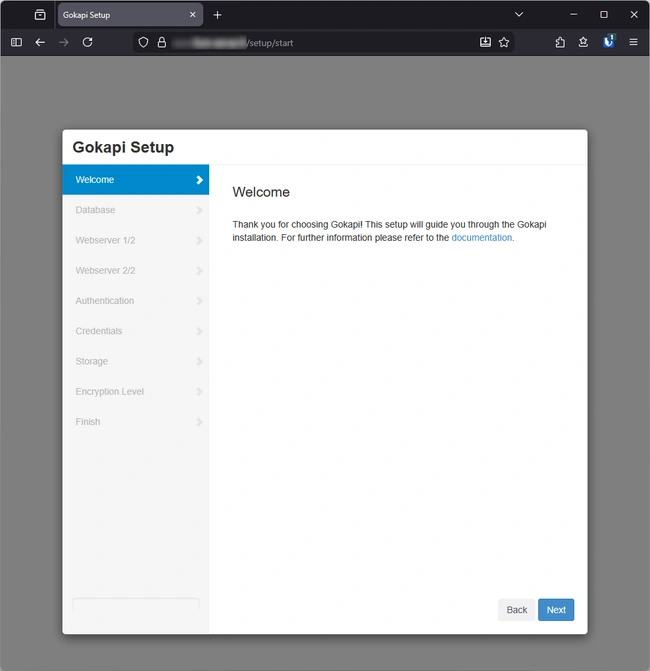
Set up the gokapi admin account immediately
A fresh Gokapi installation exposes an unsecured admin setup interface. To protect your uploads and credentials, you must complete the admin account setup as soon as the service is started.
Open the setup page at: https://gokapi.domain.fr/setup
Recommended settings:
- Use SSL: No
- Public facing URL:
https://gokapi.domain.fr/ - Redirection URL for the index:
https://gokapi.domain.fr/login
⬆️ Updating gokapi
Gokapi deploys by push: ./deploy.ps1, run from the repository's clone on a dev machine,
pushes the commit — there is nothing to build there. The push fires the bare repo's hook, which calls
podmanctl --deploy gokapi <short-sha>: it acknowledges the push,
then deploys detached: a pull, then a restart on the stack's pinned upstream images (nothing is
built), and an nginx reload once nginx -t accepts a changed
nginx/ vhost. Every deploy ends with a receipt in the bare repo, refs/deploy/running or
refs/deploy/failed, which is how deploy.ps1 learns the outcome. Follow a deploy with
sudo tail -f /var/log/gokapi-deploy.log.
🚀 Deploying a change
From the repository's clone on a dev machine:
git add -u && git commit -m "..."
./deploy.ps1
It refuses a dirty tree, or a branch that has diverged from the server, before pushing anything.
After the push it waits until the receipt names the commit (-NoWait skips the wait): exit 0
once it runs, exit 4 when its deploy failed or is still queued, naming the log. With nothing left
to push it reads the receipt instead: the server runs HEAD → exit 3 (skipped); no receipt → exit 3
marked unconfirmed, with the reason; HEAD failed or never deployed → exit 4, naming the
podmanctl --deploy left to run there.
Every push restarts the stack — a commit that only touches
CLAUDE.mdincluded.
🪝 One-time setup — hook and clone wiring
The deploy entry point is central and installed once for the whole fleet —
see Podman — Push deploys for
podmanctl --deploy and its single sudoers rule. Only the two steps below
are per-repository.
# install into the bare repo's hooks/ — fires on every push
# ${SERVICE_NAME} expands now; the rest stays literal (\$…) for git to expand
sudo tee /media/ssd/git/podman/${SERVICE_NAME}.git/hooks/post-receive >/dev/null <<EOF
#!/bin/sh
set -eu
DEPLOY_BRANCH=refs/heads/master
while read -r oldrev newrev refname; do
  [ "\$refname" = "\$DEPLOY_BRANCH" ] || continue          # only the deploy branch
  sudo /usr/local/bin/podmanctl --deploy ${SERVICE_NAME} "\$(git rev-parse --short "\$newrev")" </dev/null
done
EOF
# normalize the hook ownership
sudo chown www-data:debian /media/ssd/git/podman/${SERVICE_NAME}.git/hooks/post-receive
sudo chmod 0750            /media/ssd/git/podman/${SERVICE_NAME}.git/hooks/post-receive

# git seeded hooks/ with executable *.sample files — inert, but strip the bit
sudo chmod -x /media/ssd/git/podman/${SERVICE_NAME}.git/hooks/*.sample
The commit comes from the just-pushed ref (the bare repo already holds it) and only names the deploy in its log. Nothing else is baked in:
podmanctlderives the service directory, user, admin group, env file and log path from the name it is given.
# deploys pull non-interactively as root: pull from the co-located bare repo over a
# LOCAL path (the HTTPS origin needs a credential prompt + TTY, which a hook lacks)
git -C ${SERVICE_DIR} remote set-url origin /media/ssd/git/podman/${SERVICE_NAME}.git

# trust both repos for root so the root-run `git pull` doesn't refuse with
# "detected dubious ownership"; --system applies whatever HOME the hook runs with
sudo git config --system --add safe.directory ${SERVICE_DIR}
sudo git config --system --add safe.directory /media/ssd/git/podman/${SERVICE_NAME}.git
Without the local origin the pull dies with could not read Username for 'https://…'; without
safe.directoryit dies with detected dubious ownership. Either way the worker aborts beforepodmanctl --updateand leaves the service running on its previous build.
🧱 Upgrading gokapi
The images are pinned in gitignored env files, edited on the server — a push never moves
one: GOKAPI_VERSION in gokapi.env. Moving a pin is a deliberate step:
podmanctl --list --check            # UPDATE column shows when an upstream image moved
podmanctl --upgrade gokapi          # re-pull the images, rebuild, restart, prune the old ones
--updatenever re-pulls a tag it already holds, so a floating tag (latest,release) only moves with--upgrade; a bumped pin is pulled by either.